

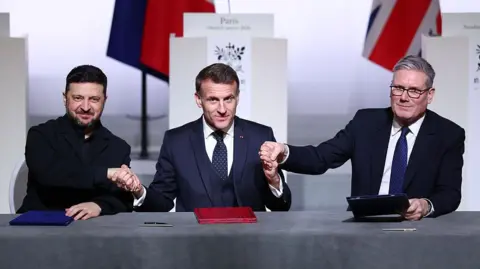
The British and French governments have signed a statement of purpose concerning the deployment of military forces in Ukraine in the event a ceasefire be struck with Moscow, the Prime Minister of Britain, Keir Starmer, has declared.
Following negotiations with allied nations in the French capital, he indicated that the UK and France would "create defense centers in various parts of Ukraine and build protected facilities for weapons and equipment" to deter any future invasion.
The allied nations also proposed that the US would take the lead in overseeing a ceasefire.
Russia has consistently stated that any external forces in Ukraine would be considered a "valid objective", but has not yet commented on this new development.
Background and Ongoing Hostilities
Moscow's leader Vladimir Putin initiated a major offensive of Ukraine in February 2022, and Russia presently holds approximately 20% of Ukraine's sovereign soil.
"This constitutes a crucial element of our pledge to stand with Ukraine for the long-term," remarked the UK Prime Minister.
National leaders and top officials from the "Partner Group" participated in the recent discussions.
He stated at a combined announcement, the Prime Minister further said: "It establishes the framework for the legal framework under which British, French, and partner forces could work on Ukraine's territory, defending Ukraine's skies and seas, and rebuilding Ukraine's defense capabilities for the future."
The PM went on to say that Britain would participate in any Washington-directed verification of a potential cessation of hostilities.
Security Guarantees and Diplomatic Positions
Top Washington representative Steve Witkoff said that "lasting defense assurances and strong reconstruction vows are vital to a permanent resolution" in Ukraine – referring to a key condition made by Ukraine.
The negotiator indicated the coalition had "mostly completed" their work on establishing such pledges "so that the people of Ukraine know that when this conflict ends, it ends for good."
The former US envoy, ex-President Donald Trump's special envoy, also was involved in the discussions.
Separately, France's leader Emmanuel Macron declared that Ukraine's supporters had made "major advances" at the talks.
He noted that "robust" security guarantees for the Ukrainian government had been agreed in the case of a possible truce.
Ukrainian President Volodymyr Zelensky commented that a "major development" had been made in the talks, but added that he would only consider efforts to be "sufficient" if they resulted in the cessation of the fighting.
Last week, the Ukrainian leader said a peace agreement was "largely prepared". Finalizing the remaining 10% would "determine the outcome of the peace, the future of Ukraine and Europe".
Unresolved Issues
- Territory and security guarantees have been at the center of key disagreements for diplomats.
- Moscow has often said that Ukrainian troops must retreat from all of Ukraine's eastern Donbas region or Russia will occupy it, dismissing any concession over how to finish the war.
- Kyiv has so far rejected surrendering any territory, but has suggested that Ukraine could pull back its forces to an agreed point – but only if Russia follows suit.
Moscow currently holds approximately 75% of the Donetsk oblast and some 99% of the bordering Luhansk. The two regions form the area of Donbas.
The earlier US-led multi-point proposal that was circulated to the media last year was perceived by Ukraine and its European allies as being strongly biased in Moscow's direction.
This led to a period of focused discussions – with all sides trying to adjust the proposal.
Last month, Ukraine submitted the US an new proposal – as well as additional documents detailing prospective defense assurances and provisions for Ukraine's rebuilding, the President stated.


